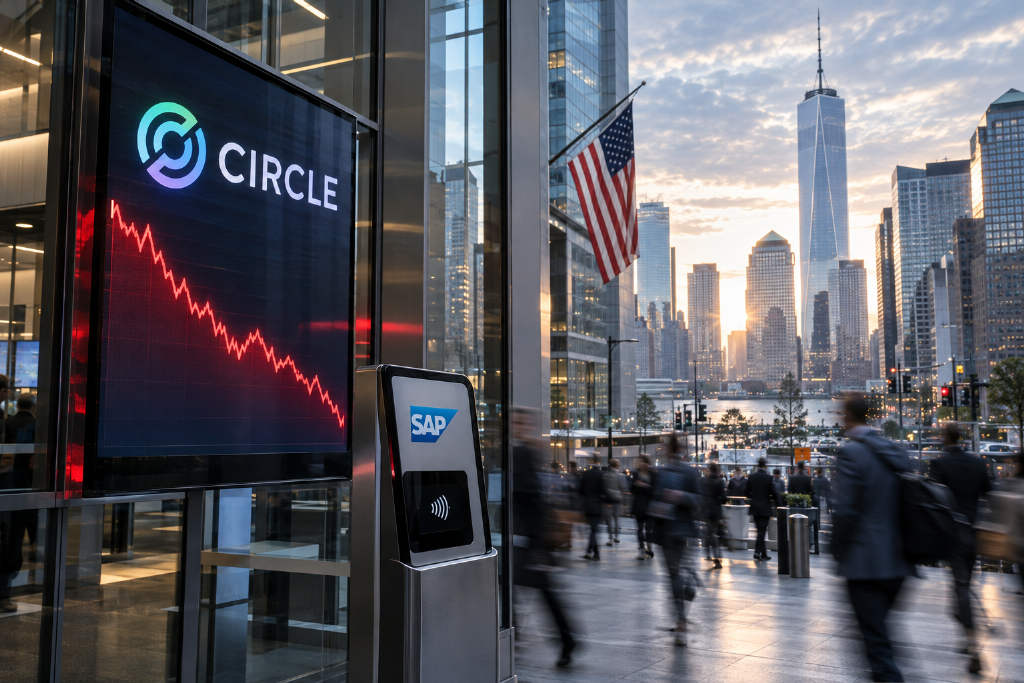
Circle2026-10-07 14:48:35Circle shares fall 4.13% to $80.65 as attention shifts to jobless claimsCircle shares fell 4.13% on Wednesday to $80.65, even as the company expanded its enterprise payments business through SAP Pay. The move came as market attention shifted to the U.S. jobless claims report due on Thursday. Investors are weighing labor market conditions and inflation risk ahead of the data release. The update, cited by Techub News from CoinGape, points to a market that is looking past the company’s business expansion for now and focusing instead on macro indicators. With the labor picture back in focus, traders are using the upcoming report to gauge how employment conditions may feed into inflation expectations.280
Bitcoin2026-10-07 08:30:46Bitcoin briefly falls below $84,000 as traders await FOMC minutes and weigh oil-driven inflation riskBitcoin briefly slipped below $84,000 during Wednesday’s Asian trading session, with investors focusing on two near-term macro signals: the Federal Reserve’s upcoming release of the Federal Open Market Committee, or FOMC, meeting minutes, and the inflation implications of rising oil prices. The move came even after U.S. spot Bitcoin exchange-traded funds, or ETFs, returned to net inflows of $118.8 million on Oct. 6 following one day of net outflows. According to the report cited by Techub News, Bitcoin still faced pressure in early trading the next day, suggesting that ETF flow improvement did not offset broader macro caution. CoinJournal said higher oil prices had intensified inflation concerns, a factor that could shape market expectations for the Fed’s next monetary policy steps. The same report pointed to $80,000 to $82,000 as Bitcoin’s key near-term support zone. On the upside, it identified $87,000 as an important resistance level. A sustained break above that area could open the way for a test of the $100,000 mark.340
Bitunix2026-09-25 12:54:04Bitunix analyst says U.S.-Iran talks eased some energy fears, but diesel shock keeps inflation risk aliveRepresentatives from the United States and Iran made contact during the UN General Assembly over a phased ceasefire proposal that would reopen the Strait of Hormuz within seven days in exchange for looser U.S. economic sanctions, according to BlockBeats. The report said the development gave markets a first diplomatic path toward restoring energy supply, and international oil prices fell nearly 2% intraday as traders began pricing in a possible recovery in flows through the strait. That signal, however, did not settle the supply picture. The two sides still face core disagreements over control of the strait and the extent of sanctions relief, meaning the diplomatic opening cannot yet be treated as actual supply restoration. At the same time, the report said energy risk has spread beyond a single chokepoint. Houthi forces launched six ballistic missiles at energy facilities including Yanbu in Saudi Arabia, putting pressure on Red Sea export routes that had been viewed as alternatives to Hormuz. Bitunix’s analysis also pointed to the U.S. diesel market as a more difficult policy problem. Retail diesel prices rose to a record $6.51 a gallon, prompting the White House to evaluate export restrictions. But with U.S. seaborne diesel exports at roughly 1.6 million barrels a day in August, tighter export controls could hurt Gulf Coast refinery margins, raise inventories and reduce refinery runs, cutting total output of gasoline, diesel and jet fuel rather than creating new supply.530
Policy Regula2026-08-27 07:16:09Simon White Warns Debt Cancellation Push Could Spread as Governments Struggle With Rising Debt LoadsMacro strategist Simon White, co-founder of Variant Perception, warned in a recent report that calls to cancel public debt in France could foreshadow a broader shift toward more radical debt policies in other heavily indebted countries. He argued that such ideas, while politically tempting, amount to monetary financing in another form and could end with higher inflation and a loss of value in financial assets. White cited French left-wing populist politician Jean-Luc Melenchon’s recent call to cancel 18% of France’s public debt, describing it as taking the bonds and “burning them.” He linked that rhetoric to earlier episodes seen during the eurozone debt crisis and in the United States. He also revisited the 2011 proposal for the US Treasury to mint a $1 trillion platinum coin, saying similar ideas may reappear as the US again nears its debt ceiling, with only $1.1 trillion remaining before it is hit. According to White, the US remains the most worrying case globally. He pointed to debt-to-GDP metrics, interest costs above $1 trillion, and a “twin deficit” larger than every major emerging and developed economy except Brazil. His report says that if orthodox options remain politically blocked, debt cancellation and other forms of monetary financing may look easier, even if they carry far greater inflation risks.1220
Coinbase Inst2026-07-14 00:37:06Coinbase Institutional says BTC’s roughly 2% drop may point to a basing phaseCoinbase Institutional said weaker-than-expected U.S. nonfarm payrolls did not ease market concerns, as escalating conflict in the Middle East pushed inflation risk back into focus. The market is now shifting toward pricing in higher rates for longer, with financial conditions tightening and long-duration risk assets coming under pressure. The firm also said the probability of another rate hike this year is rising. Even with those headwinds, BTC fell only about 2%, a relatively resilient move that Coinbase Institutional said may suggest the market is going through a bottoming process. The view links macro pressure, inflation concerns, and rate expectations to crypto price action, while pointing to Bitcoin’s limited decline as a sign of relative strength under stress.1510
BlackRock2026-06-30 09:30:14BlackRock CEO Warns: Oil at $150 Could Trigger Global RecessionBlackRock CEO Larry Fink warns that if international oil prices rise to $150 per barrel due to prolonged Middle East conflict, the global economy could face a severe recession. Fink highlights that high oil prices will not only fuel inflation and consumer costs but also undermine AI infrastructure investments. The market has already seen supply risks, with Brent crude briefly exceeding $100. Economists warn that an average oil price of $125 could push the U.S. into recession. Fink argues the current financial system is more resilient than in 2007, but energy costs remain a critical factor for future competitiveness.570
Goldman Sachs2026-06-02 23:00:50Goldman Sachs CEO Solomon: Stock Market Surge Fueled by Profit Greed, Greed Overwhelms FearGoldman Sachs CEO David Solomon said the stock market boom is driven by a craving for profits that overshadows concerns over economic turmoil and inflation. He warned that inflation risks are real and could prompt the Fed to raise rates.620